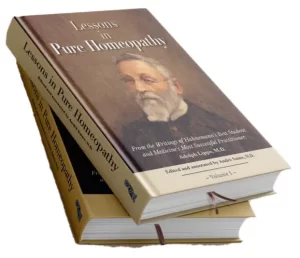
 Homeopathy has been under attack in the U.S. for several decades now, but the winds may be changing. So there is no better time for the release of this two-volume book, which is a tour de force focused on pure homeopathy.
Homeopathy would not have existed without the genius of Samuel Hahnemann who not only recognized that the Law of the Similars was a universal law in medical therapeutics, but also gave us six editions of the Organon as a practical guidebook on how to practice homeopathy. In addition, he conducted provings, which gave us a materia medica of around 100 remedies. However, almost immediately after his discovery, homeopathy came under attack from without by the allopaths and from within by those who tried to simplify the practice of homeopathy. Enter Adolph Lippe, MD, perhaps the most successful practitioner of homeopathy certainly in his time (and maybe even today), who also tirelessly defended pure homeopathy from its detractors and those trying to simplify and “improve” homeopathy, and, as a result, misrepresenting the system that Hahnemann had discovered and formulated. These two volumes clearly depict Lippe’s defense of pure homeopathy and his genius as a practitioner and explainer of Hahnemann’s elegant method. Without his vigorous defense of pure homeopathy, it is very likely that homeopathy would just be a footnote in the history of medicine with no living practitioners of the art and science of pure homeopathy.
In the Introduction, Dr. Saine explains how he discovered the works of Adolph Lippe in the library when he was a student at the National College of Naturopathic Medicine in Portland, Oregon, in 1980. He discovered a homeopathy there very different from what he was taught in and out of his classes. And he found many of the old masters of homeopathy referring back to Lippe as representing the highest standard of homeopathic practice. Because the link to that generation of homeopathy had been lost, Dr. Saine, in 1988, began the process of collecting all the various writings of Adolph Lippe so that they could be published together. While it took 36 years for this goal to be partially achieved in the publication of this book, Lessons in Pure Homeopathy, this time allowed Dr. Saine to accumulate his own clinical experience so that he could add a commentary to the works of Lippe. In fact, it is this commentary which polishes this work into a priceless gem! Mostly, Dr. Saine gives confirmation and examples of how Lippe was correct, but at times he explains how his own clinical experience led him to slightly different conclusions than Lippe; this is where this work shines the brightest. It could be said that it takes a genius to clearly and accurately interpret the works of another genius. This work is a clear example of that, and each and every reader can only be enriched in their homeopathic skills by taking the time to read this work in its entirety. Once you begin reading, it is hard to put it down!
The first chapter, “What is Homeopathy,” is comprised of two lectures that Lippe delivered which define what is pure homeopathy and what is not. In Chapter 2, “Philosophy of the Homeopathic Healing Art,” Lippe describes homeopathy’s fundamental principles. Chapter 3 is one of my favorite chapters and it is entitled “Case Analysis and the Second Prescription.” In it, Lippe describes many important points about case analysis and about evaluating the patient’s response to the remedy. Chapter 4, “The Homeopathic Materia Medica,” another favorite, describes the development of a pure materia medica, how to study it, and provides many materia medica pearls for the experienced practitioner. Chapter 5, “On Posology,” describes how to achieve the optimal posology, which is always a topic of concern for both beginning and experienced homeopaths. Finally, to round out Volume 1, we have Chapter 6, “Clinical Cases,” where, through many cured cases, Lippe shows us how to apply the Law of the Similars to obtain optimal clinical results.
Volume 2 begins with Chapter 7, “Therapeutics,” where Lippe reviews the treatment of various clinical conditions and infectious diseases. In each area he provides a precise and masterly differential materia medica of possibly indicated remedies. Chapter 8, “In Defense of Pure Homeopathy,” is perhaps the most important chapter in our current times, as in it Lippe describes the various misrepresentations, shortcuts, and other deviations from pure homeopathy. He explains how they undermine the growth and spread of homeopathy and how to remedy the situation. For homeopathy to continue as a valid and effective therapeutic modality into the distant future, it is essential that all serious homeopathic students and practitioners should absorb and reflect on the wisdom in this chapter. The future of homeopathy depends on it.
The last three chapters contain memorials written by Lippe after the deaths of Boenninghausen and Hering, and a valedictory address in which he depicts the repression of homeopathy by allopathy and the resulting great detriment to humanity. The last chapter is the last article he wrote in which he emphasizes that those who take the time to master pure homeopathy will realize the universal applicability of the Law of the Similars and that its application can achieve the greatest good for suffering humanity.
The book finishes with a series of 22 appendices which describe in more detail such topics as the use of high potencies, a case of severe complicated pneumonia, how to study the materia medica, Fincke’s fluxion method of potentization, Hahnemann’s cures, etc.
This tome is lavishly bound, and the print is easy to read. It is a must-read for serious homeopathic practitioners and beginners, as well as for those new to homeopathy and those desiring to study the history and legacy of pure homeopathy. Your time spent reading it will be well rewarded with, for the practitioner, improved clinical results and, for the simply curious, a better understanding of this amazing healing art and science called homeopathy. The book can be obtained from the Press of the Canadian Academy of Homeopathy.
