“Transformative ideas rarely emerge from dominant institutions. Instead, they arise at the margins—in small circles, independent networks, and heterodox communities operating outside the constraints of institutional legitimacy. This is not accidental. It reflects the structural incentives that shape intellectual life. Institutions reward conformity, procedural loyalty, and reputational safety. The margins reward clarity, independence, and the willingness to confront reality directly. This section explains why deep penetration so often begins far from the center of power.”1
“If the physician clearly perceives what has to be cured in disease; i.e., in each individual case of disease (Knowledge of the disease), if he clearly perceives what it is in medicines which heals; i.e., in each individual medicine (Knowledge of medicinal powers), if he applies in accordance with well-defined principles what is curative in medicines to what he has clearly recognized to be pathological in the patient, so that cure follows; i.e., if he knows in each particular case how to apply the remedy most appropriate by its character (selection of the remedy), prepare it exactly as required and give it in the right amount (the correct dose), and repeat the dose exactly when required, and, lastly, if in each case he knows the obstacles to cure and how to remove them so that recovery is permanent, then he knows how to treat thoroughly and efficaciously, and is a true physician.”2
Dear Reader,
It is an incontrovertible fact that a “transformative idea” is always strongly resisted by the orthodox system that is challenged by it. Even such ideas as “antisepsis” met fierce attacks from physicians who would not accept the fact of iatrogenesis: physicians could be carriers of disease with a high mortality rate in women hospitalized after childbirth with puerperal fever in the 19th century. (see Dr. Ignaz Semmelweis and his abominable treatment by his colleagues.3)
In his seminal work on medical history, Divided Legacy, in four volumes Harris Coulter divides the two schools of medicine into the Rationalists and the Empiricists. The Rationalists come to their conclusions a priori by forming theory or hypothesis first and
then looking for evidence to back it up. In contrast, the Empiricist school observes the facts first and then forms a hypothesis that is again retested and confirmed by experience. Samuel Hahnemann is placed squarely in the camp of the Empiricists.4 The development of homeopathy was based on Hahnemann’s experiments which led to provings (based on John Hunter’s work) or pathogenetic trials of natural substances.5 The principle of homeopathy, Similia Similibus Curentur, is itself a hypothesis that was derived from observation using the inductive method of logic. This hypothesis becomes “law” when it has been extensively tested by experience. Thus, according to Hahnemann, it is research and pure observation alone which allows us to make valid conclusions as to the best method of cure. What has prevented this experimental method and principle of Hahnemann from becoming accepted in medicine?6
The answer is complex. But in the main, we can answer that the dominant school of Rationalism in medicine, without giving up its “a priori” approach, incorporated the experimental method to further its own (economic) ends. An example of this is evident when we examine closely the Germ Theory of Disease that was advocated by Louis Pasteur which looks to a single pathogenetic agent in the form of a bacterium that causes a particular “disease.” Of course, we know now that the human microbiome includes in its ecology both the “good” and the “bad” bacteria which contribute to the health of the organism. It is not so much that we deny the association of a particular disease with a bacterial agent (e.g., the need for antisepsis in surgery) but that we are also acutely aware that the “terrain”—or the internal and external environment—contributes even more to morbidity and mortality than any one agent. (See Bechamp and Pasteur.7)
Up to now, the orthodox medical approach continues to dominate the modern medical world. The pharmaceutical industry has made the treatment of disease with patented drugs an extremely profitable enterprise. The most recent revision in the evidence base of medicine (EBM) has made the top of the evidence pyramid the systemic reviews of Randomized Control Trials. This (essentially political) maneuver effectively makes any medical research trial not run by entities which can afford a huge outlay in funds, such as large medical corporations or government bodies, inferior and relegated to “observational” status at best.
In response to this, we can reiterate that homeopathy has clearly come from the application of scientific method in medicine, its research consisting of carefully conducted pathogenetic trials to discover the drug effects of natural substances, and just as carefully developed the effective application of its methodology in many acute diseases —from cholera to present day Covid—and chronic diseases, forming an unshakeable evidence base from many nations over a 230 year history.8 The so-called (materialistic) mechanism of action (MOA) is called for only in a mechanistic and reductionistic paradigm of biology but does not apply to a system of medicine such as homeopathy that is holistic, vitalistic, individualistic, and cutting edge (nanomedicine) in its essence. How does homeopathy actually work? This can only be discovered completely through further research into homeostasis, hormesis, systems theory, and nanomedicine—in other words, research with the object of revealing the curative power of the organism and examining ways to augment that power: research that serves the ideal of cure.
Let us not despair and have faith that the day will come when all fields of scientific and artistic endeavor will actually serve the best interests of the majority of humanity and not just the privileged few.

Respectfully yours,
Alex Bekker, MD
Editor, AJHM
Board Member, American Institute of Homeopathy
References:
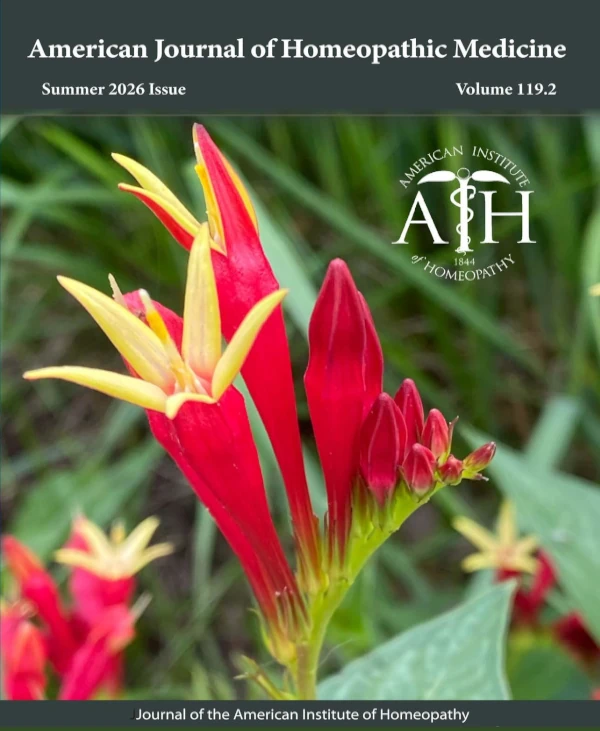
The American Journal of Homeopathic Medicine (AJHM) is a peer-reviewed scientific journal, specifically intended to meet the needs of physicians involved in the specialty of homeopathy. The editor invites original manuscripts, feature articles, research reports, 'Homeopathic Grand Rounds' cases studies, abbreviated case reports for 'Clinical Snapshots,' seminar reports, and position papers that focus on homeopathy, as well as book reviews and letters to the editor. Click below to subscribe to the Journal.
Table of Contents
The American Journal of Homeopathic Medicine (AJHM) is a peer-reviewed scientific journal, specifically intended to meet the needs of physicians and other practitioners involved in the specialty of homeopathy.
Your membership is your connection to the oldest professional organization dedicated to homeopathic medicine in the United States. Renew today to continue receiving exclusive resources, professional support, advocacy, and access to a community committed to advancing homeopathy.