
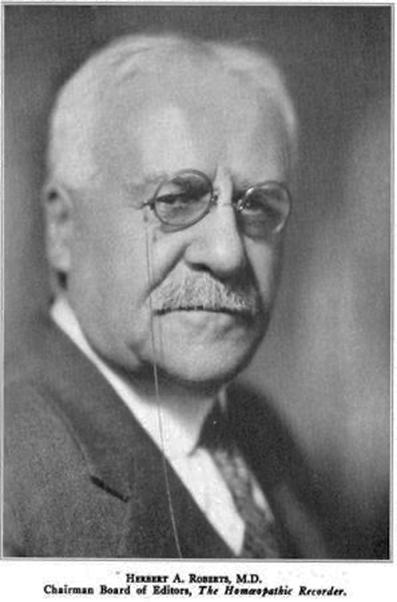
 This article was first published in 1936. The excerpt from his work reads like a modern treatise on the subject. Please examine the references below to illustrate the main points in this incisive and moral document. These references will illustrate the study of the important concepts from altruism, to cutting edge science in hormesis, to facial microexpressions, the biological concept of complex adaptive systems, and finally homeopathic pathogenetic trials—provings.
What has homœopathy to offer the young man as a future?
This question comes to us repeatedly and in our changing economic conditions it is a pertinent question …
If he replies to your question of his idea of the direction of his future so that it leads you to think that he looks upon sick humanity as suffering men and women, that he has a burning desire to serve them, to help them to better health and therefore greater usefulness and happiness, then you may be sure there is a sound foundation upon which we may build a plan of life in which homœopathy will offer him great reward. We can proceed further with our probing of his character and abilities, and determine what homœopathy has to offer him by finding out what he has to offer homœopathy.
One of the first essentials, now that we are convinced of his unselfish desire to serve, is to determine whether he has stability.2 If he is mercurial in temperament, easily influenced, and finds it difficult to hold a straight course, always seeking the easiest way, do not encourage him to study homœopathy. Homœopathy is founded upon principles that are in turn founded upon natural laws. If homœopathy is founded upon natural law, it is as basic and eternal as the hills; more, natural laws were formulated before the hills came into being. If a man [or woman] follows where homœopathy leads, he must be able to follow those laws and to hold close to them regardless of the pressure of influence.3
Stability of character must have with it, and in equal measure, the quality of patience. In ordinary medicine the quality of patience seemingly is not so necessary, since we too frequently find that in extreme cases where things have taken an undesirable course the physician conforms himself that “everything possible has been done for the patient.” In homœopathy, one of our greatest axioms is: WHEN IN DOUBT, DON’T. The homœopathic physician must be able to plan his course, and once having determined upon it, to stick to it until he finds good reason for changing his course; he must be able to wait.
The man who considers homœopathy as a possible future must be a student of people and willing to become a student of philosophy. He must be able to read between the true and the false in any symptoms the patient may give; he must possess a sense of values. He must train himself to observe all those signs which the vital energy writes upon the human face4, and he must be able to interpret all the signs, which show through habits and circumstances, into indications for the health-restoring medicines which he has at his command. Hours must be spent in patient study, tracing the course of the disturbance and the remedy to fit it, always basing the process upon the sound rock of natural law.
To the young man who is equipped, and willing to undergo the training for this lifelong task, homœopathy has everything to offer.
In the first place, homœopathy offers to the independent mind an opportunity continually to seek new verifications of the natural laws upon which this system of medicine is based. It opens up vast fields to the pioneer, and we cannot gauge the distance that eager minds may travel, nor how greatly the interpretations of these laws may influence the civilization of the future.5
Homœopathy offers a life of service to humanity, and it is the only method of healing that surely sets the sick man and sick woman on the permanent road to recovery. We must remember that though we may fail, the failure is ours; it is not the failure of homœopathy. The better knowledge we have of the “tool of our trade” the better use we should make of them.
Homœopathy treats the sick individual; it is therefore a speciality. In spite of the trend toward group practice, group thinking and even group mode of life as seen all about us today, we have yet to be convinced that the man is not greater than the mass and that as long as intelligent thinking people realize and prize their individuality, the individual approach will hold an appeal to them. Therefore, homœopathy offers a special inducement to the man who can teach people to think and act as individuals, and to demand medical treatment as individuals.
Homœopathy considers the man as a whole, not just his individual parts. Therefore, primarily homœopathy has less appeal for the man of mechanical bent, for it is this man who makes the best surgeon. Instead, homœopathy offers a gentler way toward health of the entire individual… .6
One of the outstanding problems today is cancer. It intrigues the mind of the young man, and his search for the cause and cure of cancer is indefatigable. This is a challenge to the homœopathic physician as well, since he has remedial aids that ordinary practice knows not; but let the young man consider this problem in the light of public health service and its insistence on the use of serums and vaccines. Let him weigh his ability to stand upon his adherence to fundamental principles. If he takes up the task on the frontier of cancer study, will he remember the relationship between homœopathy (not isopathy) and disease conditions, or will he forget that human cell tissue is easily stimulated to over-growth, under certain hereditary tendencies? He has here a field for work which offers much elbow room and all the dangers of the pioneer.
The homœopathic school accentuates the study of the action of drugs upon healthy human beings, with little consideration of their action on the lower animals, for homœopathy recognizes that it is only through a knowledge of their action on man that we can obtain a correct perception of their applicability in disease. The field here is ripe for much investigation, and the results of such investigation would enrich the homœopathic materia medica by completing provings of some of the older remedies, and by bringing out provings of new remedies. This is an opportunity that only homœopathy offers, for the teaching of remedy reaction has ceased in ordinary medical colleges.7
The decision lies with the individual, and what he is determined to secure from his life work. If it is financial ambition, he had better not take up homœopathy. Homœopathy is a principle, and principles brook no division of loyalty. If he has at heart the desire to serve, he may find fame and riches at his door as well as that keen satisfaction of knowing that he has brought to his clientele the gift of healing in the safest, gentlest and most rapid manner.
For the man who can help the community, as individuals, toward a higher level of health, the community has a place of honor; for the man who can assist Nature to cure serious illness a certain fame in the community there is burning, perhaps not the bright flame of the comet, but a steady glow of light for his path. For the man who spends himself unceasingly for those about him the community will return a comfortable livelihood, not the spectacular fortune offered in some lines of endeavor, but a competence which will enable him to keep his family in a well-earned place in the community.
Homœopathy as a profession carried a challenge. The possibilities of its art are infinite.
What future has homœopathy to offer to you? Young man, what have you to offer homœopathy?