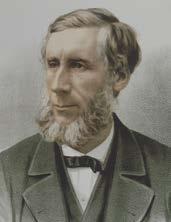
“It is not to the point to say that the views of Lucretius and Bruno, of Darwin and Spencer, may be wrong. I concede the possibility, deeming it indeed certain that these views will undergo modification. But the point is that, whether right or wrong, we claim the freedom to discuss them. The ground which they cover is scientific ground; and the right claimed is one made good through tribulation and anguish, inflicted and endured in darker times than ours, but resulting in the immortal victories which science has won for the human race. I would set forth equally the inexorable advance of man’s understanding in the path of knowledge, and the unquenchable claims of his emotional nature which the understanding can never satisfy. The world embraces not only a Newton, but a Shakespeare-not only a Boyle, but a Raphael-not only a Kant, but a Beethoven—not only a Darwin, but a Carlyle. Not in each of these, but in all, is human nature whole. They are not opposed but supplementary-not mutually exclusive, but reconcilable.”
– Tyndall, John. The Beginnings of Things; or, Science versus Theology: An Address by Prof Tyndall before the British Association for the Advancement of Science, August 19, 1874. Josiah P. Mendum,1874. p. 71
Dear Reader,
Welcome to the Winter 2026 Edition of our Journal.
 We are happy to present this issue full of articles which will stimulate your thought and emotion. It is clear that in the advance of all the sciences and arts of humanity both understanding and heart are necessary.
In the quote above from the great 19th century Irish physicist John Tyndall, we would add Hahnemann as embracing both. In challenging the prevailing orthodox medical paradigm, we are presenting the evidence for a future conception of medicine and nature that transcends the materialistic views of our time. In many fields of modern endeavor this is occurring—to give two examples: quantum physics and nanotechnology. It is through experiment, intellect and intuition that Hahnemann arrived at the basis of homeopathy.
In our eagerness to prove to the world that our work is not “placebo”, let us not forget that the greatest gift we can give to humanity is to actually “cure” as Hahnemann nobly and simply stated in the first aphorism of the Organon. The prerequisite of the physician as a “medical observer” is the state of being a balanced, resolute, attentive, and healthy person oneself before setting off to “cure’ anyone. As Hahnemann astutely states, “This capability of observing accurately is never quite an innate faculty; it must be chiefly acquired by practice, by refining and regulating the perceptions of the senses, that is to say, by exercising a severe criticism in regard to the rapid impressions we obtain of external objects, and at the same time the necessary coolness, calmness and firmness of judgment must be preserved, together with a constant distrust of our own powers of apprehension.”1
I would further state that just as much as the practitioner of homeopathy has to combine in himself the best aspects of the heart and understanding, the future scientist—an Einstein of his age—fully explaining that mystery which homeopathy is, will have to have the same qualities.2
Nevertheless, in the meantime, we fully embrace this divine gift for the alleviation of suffering and the upliftment of humanity!